You’ve seen it before: the website photos look perfect, the reviews glow, and the infinity pool seems to stretch into the horizon. Then you arrive with two tired kids and discover there’s no crib in the room, the only restaurant opens at 7 pm, and the “kids’ pool” is a corner of the deep end. A family resort checklist exists to stop exactly that from happening.
Instead of being seduced by drone shots, you’ll filter resorts through twelve features that actually matter when you travel with children: sleep setups, water safety, kids’ clubs, food for picky eaters, and the logistics of getting there without a meltdown. Below, we break down why a checklist beats pretty photos, how to choose rooms that fit a family of four, what to look for in pools and beaches, how childcare and age coverage work, how to handle dining with fussy kids, and how to book smart around airport transfers and school holidays.
Why a Family Resort Checklist Beats Pretty Photos
Resort marketing is built for couples, not families. The photos you scroll past showcase infinity pools, swim-up bars, spa treatments, and sunset terraces. What they almost never show is a crib, a kids’ menu, a shaded shallow pool, or a high chair that doesn’t wobble. Those details decide whether your trip runs smoothly, yet they’re buried in fine print or missing entirely from the listing.
That’s the gap a checklist closes. Instead of comparing which resort has the prettier beach, you compare which one can actually house, feed, and entertain your children. It turns browsing into a filter: if a resort fails three or four core features — say, no kids’ pool, no early dinner seating, and no room big enough for four — you skip it, no matter how stunning the photos look. That discipline saves you from booking a beautiful place your family will struggle to enjoy.
What the 12 features cover
The twelve features fall into four groups: sleep, safety, food, and downtime. Sleep covers room size and bed configurations. Safety covers pools, beach entry, and supervision. Food covers kids’ menus, early seatings, and allergy handling. Downtime covers kids’ clubs, teen zones, and childcare that gives parents a real break. Match each feature to your kids’ ages, and you’ll quickly separate resorts that genuinely plan for families from those that just tolerate them.
Rooms and Sleep Setups That Fit a Family of Four
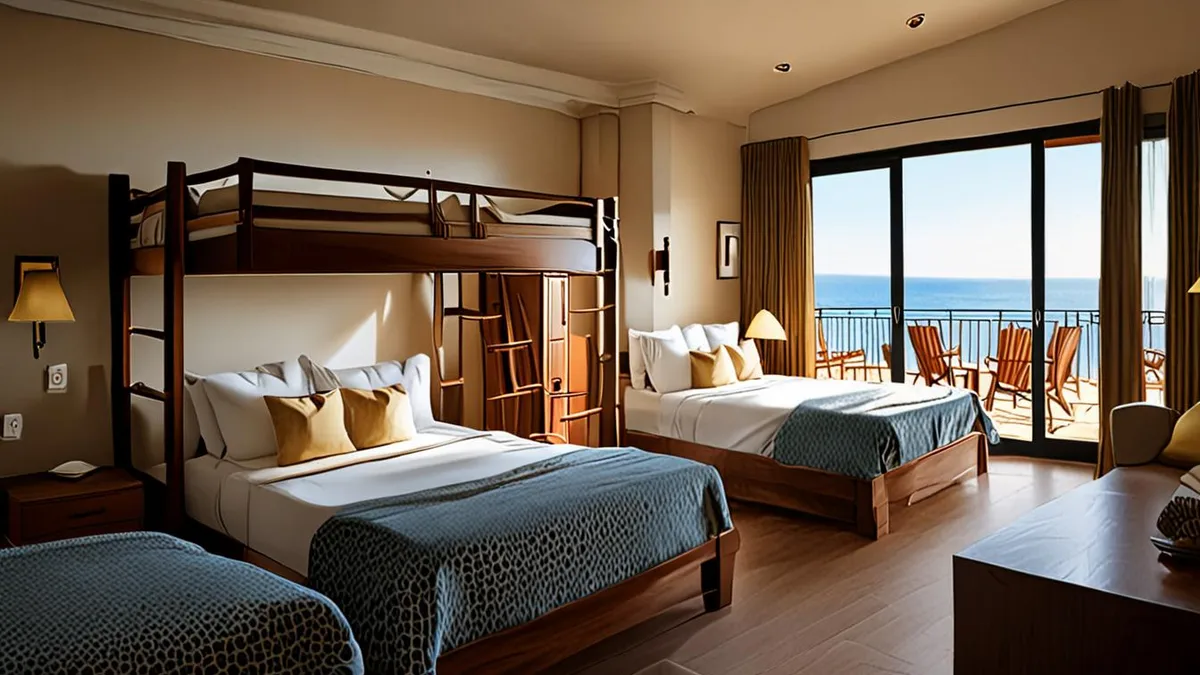
The most common family travel mistake is booking a standard room and hoping for the best. A room built for two adults rarely sleeps four comfortably, and a family squeezed into 25-30 sqm with two kids will feel it by night two. Family rooms and suites that genuinely work usually start around 35-45 sqm, often with a separate sleeping area so kids can go to bed while parents stay up. Connecting rooms are another strong option when your kids are older and you want real space and privacy.
Bed arrangements deserve a phone call or an email before you pay, not a hopeful question at the front desk. Cribs and rollaway beds are often free or low-cost, but resorts keep limited numbers, so request yours at booking and get the confirmation in writing. Ask exactly what you’ll get: a proper crib for a toddler, a bed rail for a child who rolls, and whether the rollaway fits without blocking the balcony door.
- Mini-fridge: essential for chilled bottles, yogurt, cut fruit, and milk for bedtime, especially in hot destinations where everything warms up fast.
- Kettle: lets you prepare formula, warm cereal, or instant noodles for a fussy eater without trekking to a restaurant.
- Blackout curtains: often overlooked, but they keep kids asleep past sunrise in tropical destinations where the sun rises early.
- Balcony or terrace safety: check railings and gaps before you unpack, particularly with climbers under five.
Finally, watch for signals that a resort genuinely plans for children rather than just accepting them. Bunk-bed rooms, a kids’ check-in with a small welcome gift, child-sized robes, or a step stool in the bathroom all point to a property that thinks about families in the details, not just in the brochure.
Pools, Beaches, and Water Safety Features
Water is where family trips are won or lost. The single most useful feature you can look for is a dedicated kids’ pool under 0.6 m deep, separate from the main pool so toddlers can splash without being knocked over by older swimmers. Pair that with lifeguards on duty during opening hours, and you’ve dramatically lowered the stress level of every pool day. If a resort’s only pool is deep throughout, or the “kids’ area” is a corner of the main pool, keep looking.
Beach entry matters just as much if you’re choosing a seaside resort. A gently sloping, sandy entry lets toddlers walk into the water at their own pace, while steps, ladders, rocks, or a sudden drop-off turn every beach trip into a carrying operation. Look at guest photos rather than official renders — they show the real shoreline, including seaweed, rocks, and how shallow the water actually stays.
- Shade over the kids’ pool: umbrellas or pergolas matter in tropical destinations, where midday sun can end swim time within an hour.
- Pool fencing and gated access: ask whether the kids’ pool is fenced and whether unsupervised access is possible at night.
- Supervised hours: confirm when lifeguards are actually on duty, since many resorts staff pools only during peak daytime hours.
- Water temperature: heated pools extend the season in cooler months, while unheated pools can be too cold for toddlers outside summer.
One more thing to weigh: pool count. Resorts with 2+ pools, including at least one shallow kids’ pool under 0.6 m deep, suit families best because you can escape the crowded main pool — complete with pool games and a swim-up bar crowd — and find quiet water time when your kids need a calmer session. Ask about pool fencing and supervised hours before booking, not after you arrive.
Kids’ Clubs, Childcare, and Age Coverage
A kids’ club can be the difference between a relaxing trip and a week of entertaining bored children by the pool. Most kids’ clubs accept children from around ages 4 to 12, but that’s where the similarity ends. Some run a few hours in the morning only, others offer full-day programs, and the quality of activities varies enormously from supervised crafts and treasure hunts to little more than a TV room with a staffer nearby.
Before you book, treat the kids’ club like any other resort facility and ask specific questions. Verify the opening hours, whether lunch is included in a full-day session, and if the club is free or charged per session or per day. At many all-inclusive resorts the club is part of the package, while at smaller properties it can be a meaningful add-on to your budget.
Don’t forget older siblings. Resorts with teen zones up to age 17 keep teenagers engaged with gaming rooms, sports courts, and social spaces, which matters if you’re traveling with a wide age spread. And for evenings, babysitting services commonly range from $15-30 per hour — booking an in-house sitter through the resort for one or two adult-only dinners is usually money well spent.
- Staff-to-child ratios: ask how many children each staff member supervises; lower ratios generally mean more individual attention during crafts, games, and pool-adjacent activities.
- Certifications: check whether club staff are certified in childcare or first aid, not just seasonal entertainment hires.
- Sign-in procedures: confirm whether parents must sign children in and out, and whether the club contacts you if a child wants to leave early.
- Indoor backup space: a shaded or air-conditioned indoor area keeps the club usable during midday heat or a rainy afternoon.
- Age flexibility: some clubs allow slightly younger children if a parent stays with them — useful for families with a three-year-old who wants to join in.
Food That Works for Picky Eaters and Early Dinners
Food can quietly make or break a family resort trip. Hungry kids don’t wait patiently for a three-course à la carte dinner, which is why buffets with dedicated kids’ stations usually work best. Children can see the options, serve themselves, and eat within minutes, while parents aren’t trapped in a formal dining room past bedtime.
Check the practical details before booking, not after you arrive. Confirm there’s a kids’ menu at the other restaurants, that high chairs are actually available (and cleaned without a 20-minute wait), and that there’s an early dinner seating — ideally around 5:30-6:30 pm. A resort that seats families at 8 pm may look sophisticated in photos and be miserable in practice with a toddler.
An all-inclusive plan can also remove a lot of friction. Family all-inclusive resorts typically run $250-600 per night for a family of four, and while that’s a significant number, it means no per-meal stress, no surprise minibar bills, and no negotiating over whether a poolside smoothie counts as an extra. If you prefer à la carte dining, at least confirm what’s included before you commit.
- Allergy protocols: ask how the kitchen labels dishes and handles cross-contamination, especially with nuts, dairy, and gluten.
- Plain-food flexibility: confirm the kitchen can prepare simple dishes like plain pasta, rice, or grilled chicken for genuinely picky eaters.
- Snack access: look for poolside snack bars or grab-and-go options between meal times, since kids rarely align their hunger with restaurant hours.
- Bottle and baby-food help: some kitchens will warm bottles or milk and prepare simple baby food on request — worth confirming if you’re traveling with an infant.
- Water and drinks: check whether filtered water, juices, and milk are freely available or counted as paid extras.
Location, Transfers, and Booking the Family Resort Checklist Way
Where a resort sits matters more with kids than it ever did as a couple. Aim for a transfer under 60 minutes from the airport — a short ride reduces arrival-day meltdowns significantly, especially after a long flight with tired children. A two-hour minivan journey with a carsick six-year-old is not the vacation start anyone hoped for.
Walkable surroundings are the other underrated factor. Safe paths, a small shop for snacks and sunscreen, and yes, an ice cream spot within strolling distance give your days flexibility. Remote luxury can be wonderful, but if every outing requires a taxi and a 30-minute drive, you’ll simply stay at the resort — which is fine, as long as you know that going in.
Timing your booking matters too. For regular high season, book 3-6 months ahead to get your pick of family rooms and suites. The peak school-holiday windows of June-August and mid-December to early January are a different story: they often sell out 6+ months early, and the best family rooms go first.
- Children’s pricing policies: confirm the exact age cutoff for kids staying or eating free — it varies widely between resorts and can change your total significantly.
- Transfer options: ask whether the resort offers private or shared airport transfers, and whether child car seats are provided or need to be requested in advance.
- Room location within the resort: request a room close to the kids’ pool and main restaurant; a “short” walk on a map can feel long with sandy, tired children.
- Deposit and cancellation terms: family bookings often span several rooms or longer stays, so check what’s refundable if plans change.
- Extra-bed and occupancy rules: some resorts limit how many children can share a room, so verify your family configuration fits before paying.
Wrapping Up Your Family Resort Checklist
The gap between glossy resort photos and reality is exactly what this family resort checklist solves. The twelve features cover rooms and sleep setups, water safety, kids’ clubs, dining, and the logistics that make or break an arrival day. Together, they answer the questions marketing photos never will: where your kids will sleep, what they can safely swim in, and what they can actually eat at 6 pm.
The trick is matching each feature to your kids’ ages. A toddler needs shallow water and a crib; a ten-year-old needs a kids’ club; a teenager needs a teen zone. Resorts that fail three or four core features for your family are the ones that only look family-friendly. And when peak school-holiday windows roll around, booking early is what secures the best family rooms before they’re gone. If this checklist helped you plan, share it or leave a comment with the features that matter most to your crew.